Task Assessment for Ease & Risk — Independence
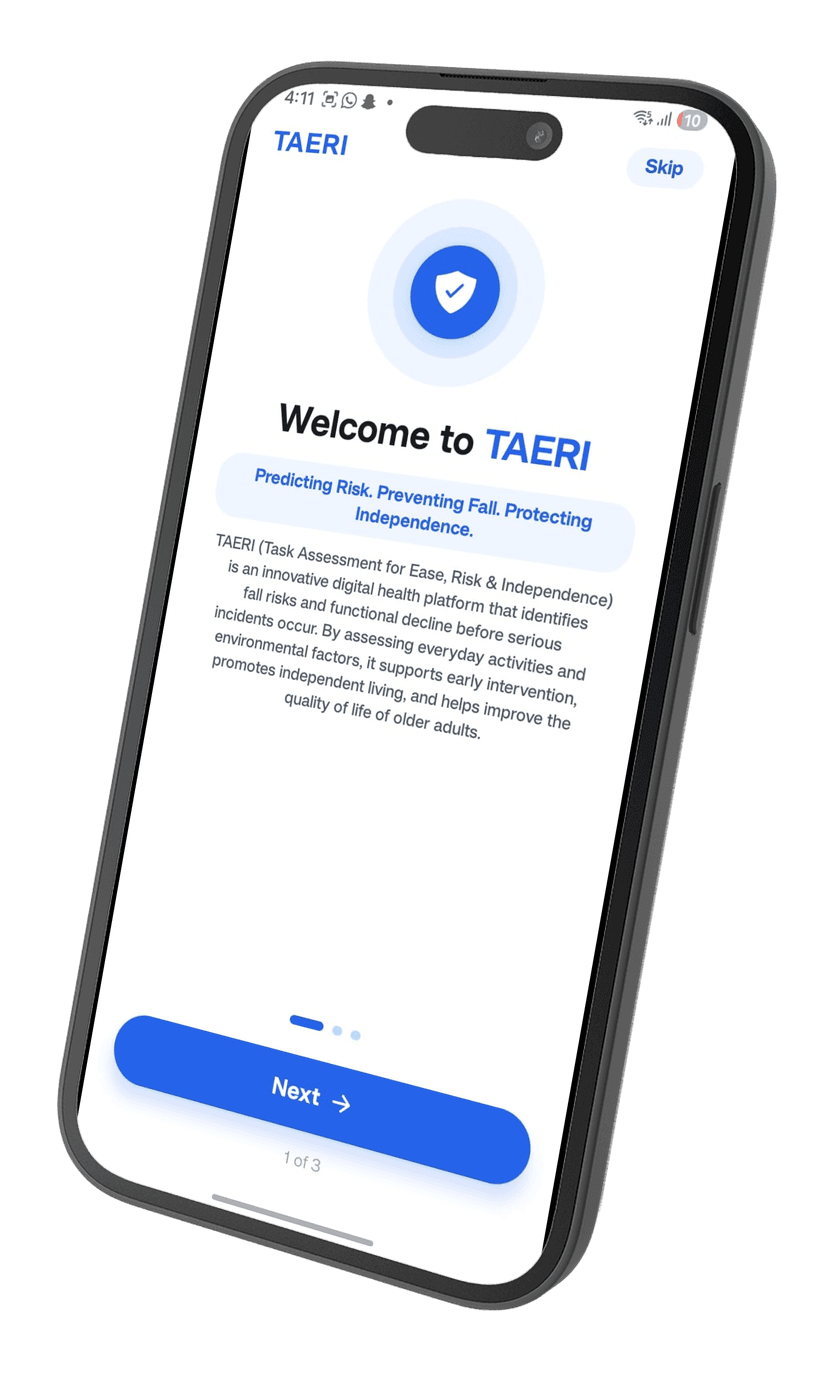
TAERI turns a validated piece of ergonomics research into a proactive telehealth platform — spotting rising risk in ordinary chores like laundry, cleaning and shopping, weeks before they lead to a fall or a hospital visit.
78%
Sensitivity in trial
76%
Overall accuracy
3
Validated parameters
This week's task log
LiveWhy do we need TAERI?
Existing ergonomic tools were built for factories and warehouses — for tasks that are supervised, repetitive, and predictable. Home life is none of those things, which is exactly why the risk inside it goes unnoticed until something breaks.
Too Late
In most cases, functional risk is only identified after a fall or an injury has already happened — not before.
Episodic
Formal assessment usually happens only during scheduled clinical visits, leaving long gaps where nothing is being observed at all.
Invisible
Functional decline at home is gradual and largely unnoticed — by the person experiencing it and by the clinicians who could act on it.
Can we identify functional decline before a crisis occurs?
How it works
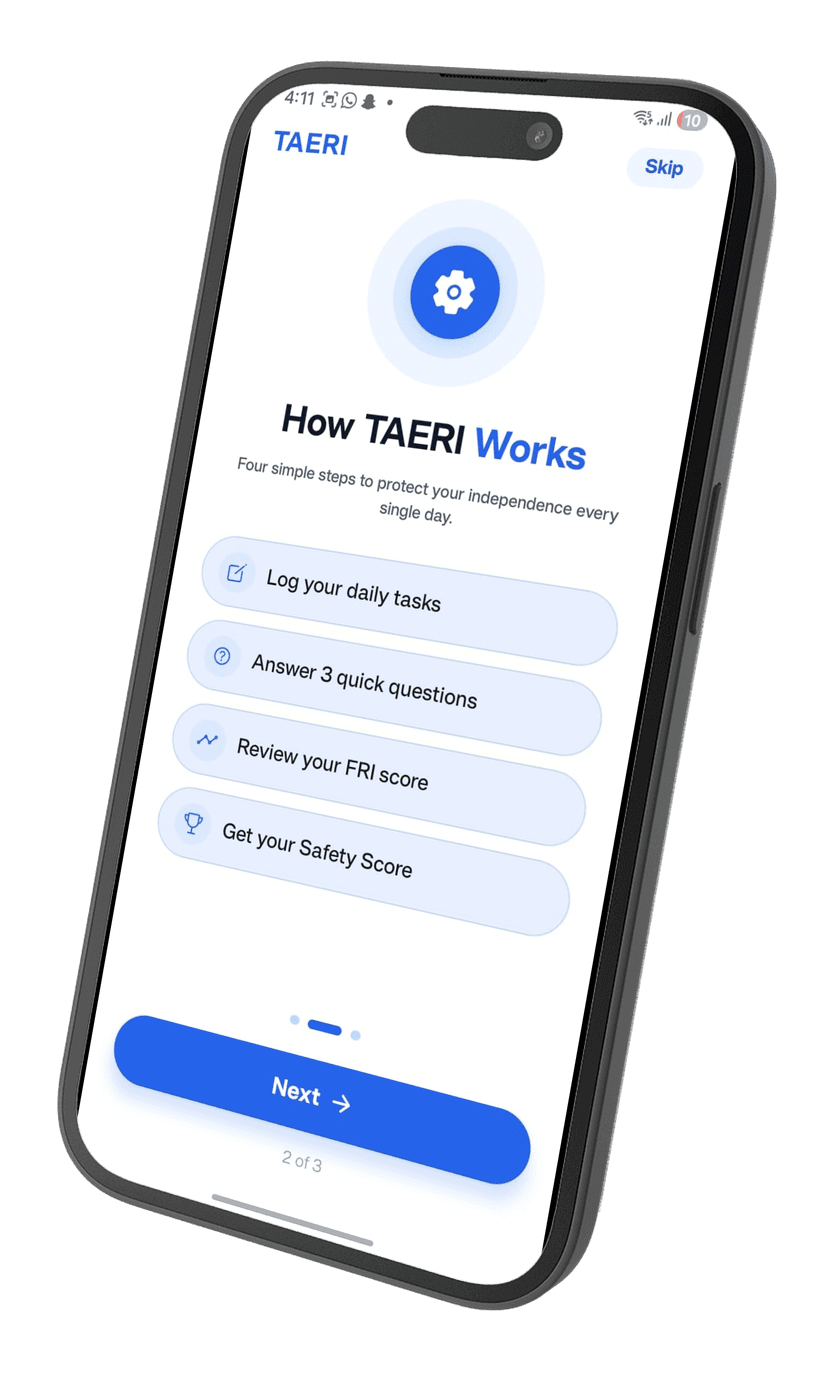
Every assessment follows the same validated flow as the original paper-based TAER guide — just faster, and shared with the people who can act on it.
Step 01
e.g. cleaning, laundry, shopping — picked from a short list, no typing required.
Step 02
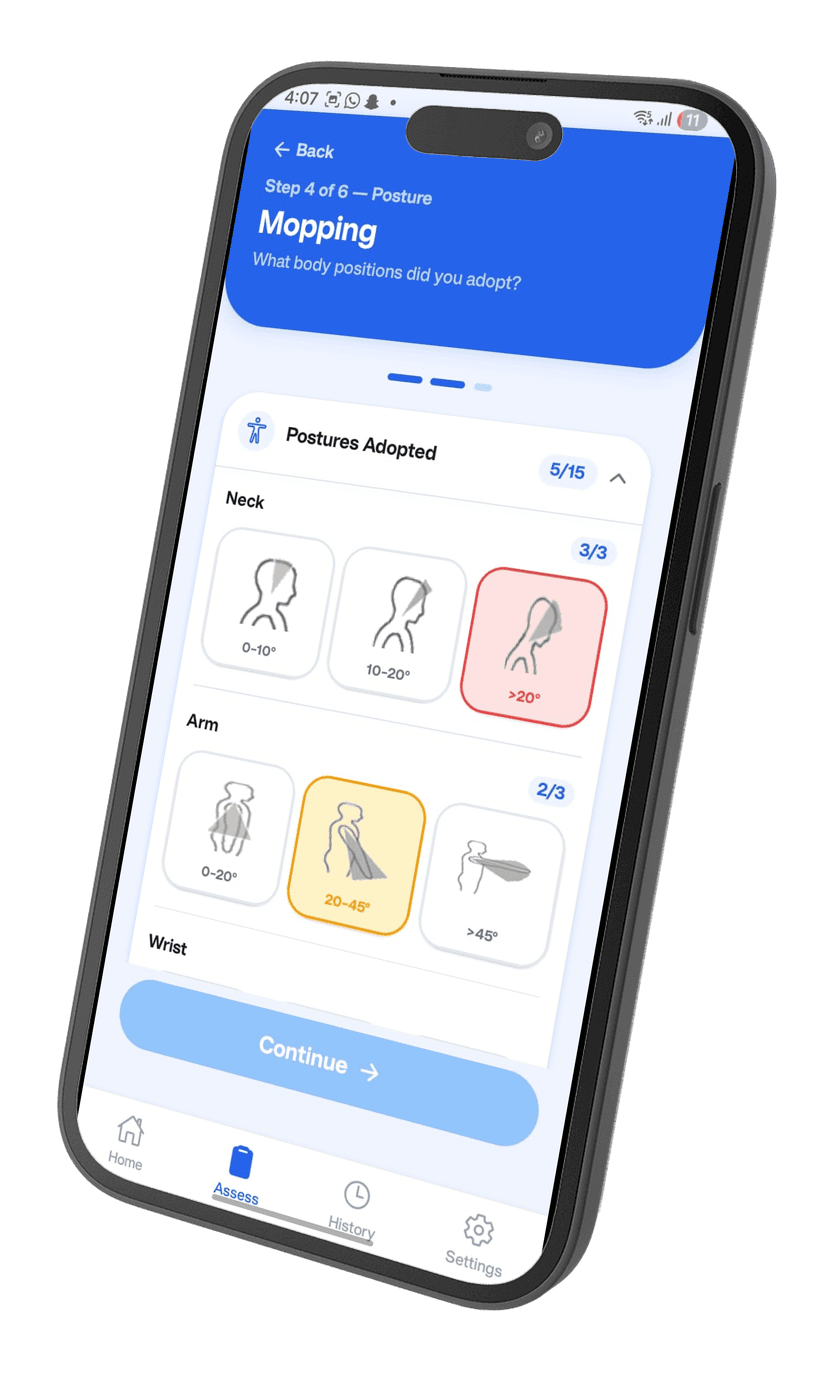
Psychological perception, body posture (neck, back, arms, legs), manual handling, frequency & duration, and the Fall Risk Indicator — how stable did you feel?
Step 03
Perception, posture and handling scores are combined and adjusted by a frequency-and-duration multiplier to produce one exposure score. The Fall Risk Indicator is recorded alongside it.
Step 04
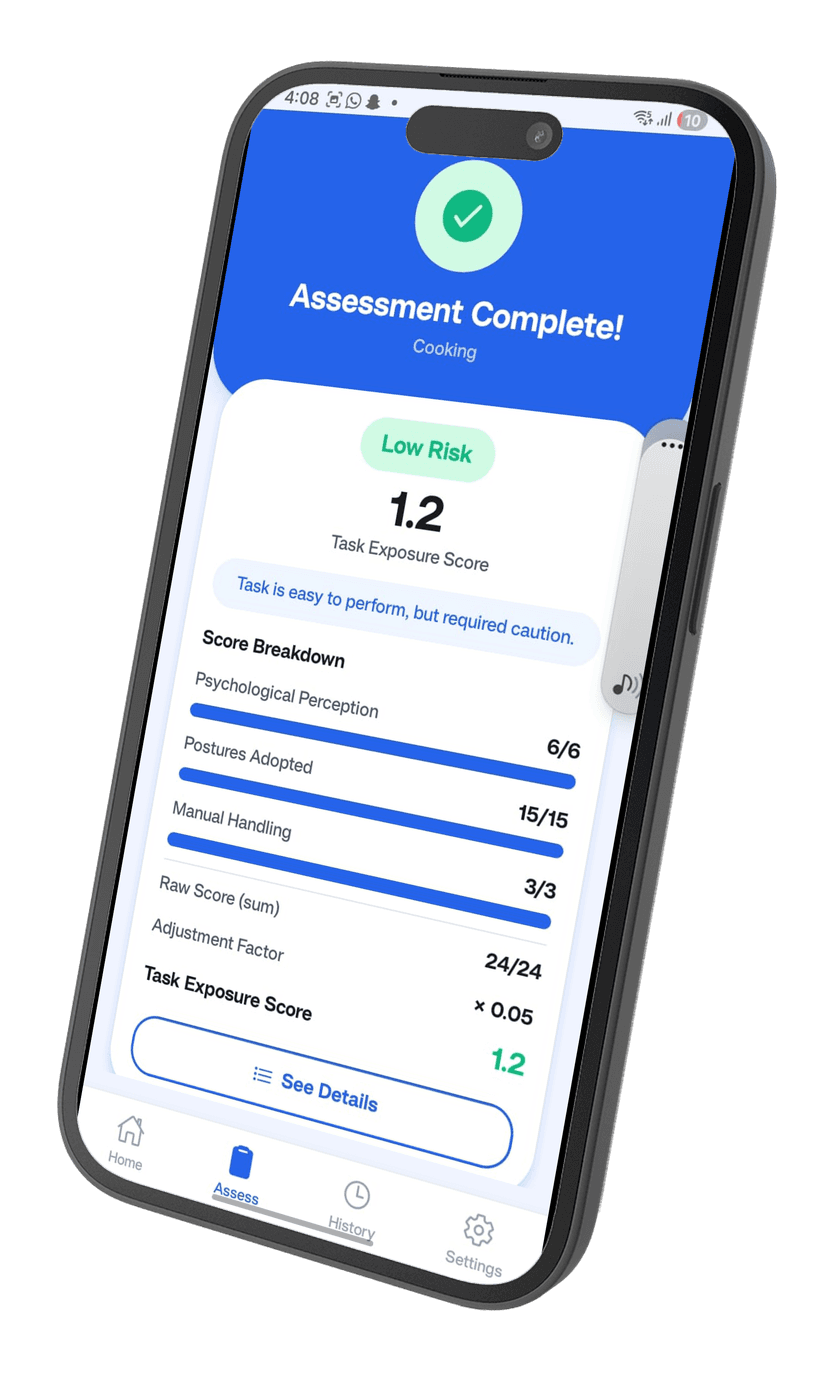
A task risk level — Low, Moderate or High — plus a stability read-out, a short explanation, and a practical tip for reducing the risk next time.
Step 05
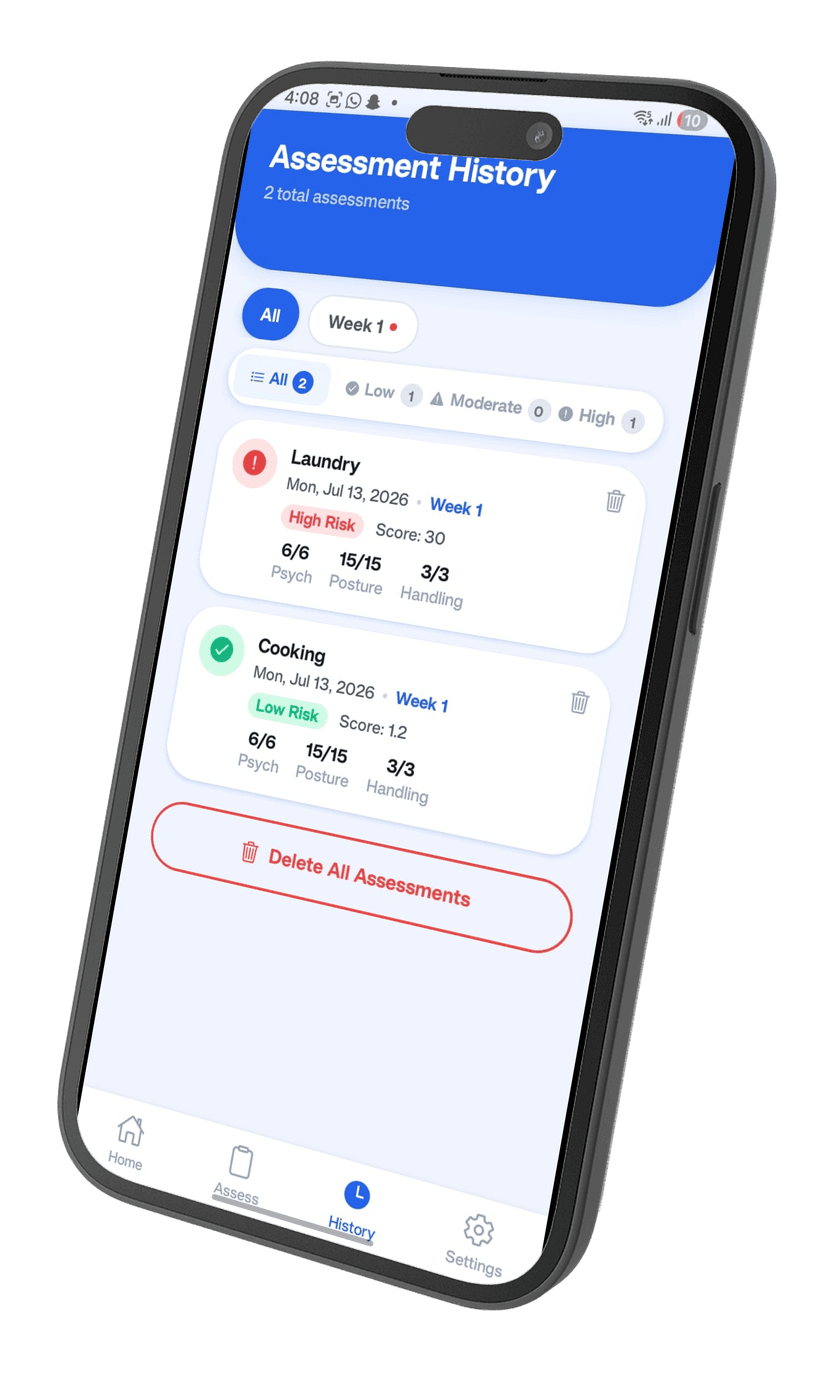
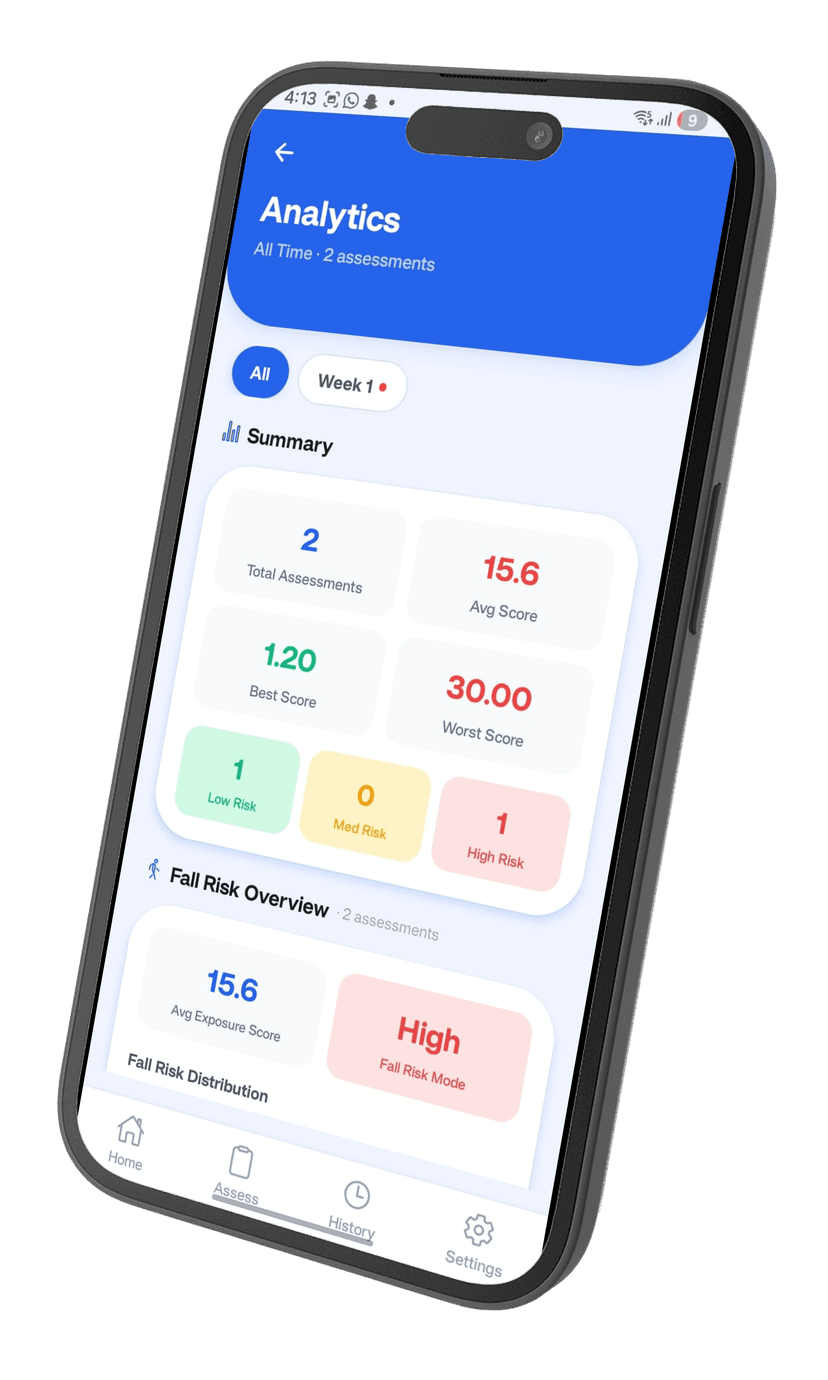
Weekly patterns, repeated high-risk tasks, and shifts in confidence or stability are tracked over time — no extra effort from the user.
Step 06
When a patient is connected to a clinician, the same trends surface on a dashboard — with alerts for worsening or persistently high-risk tasks, supporting earlier intervention.
The TAERI app
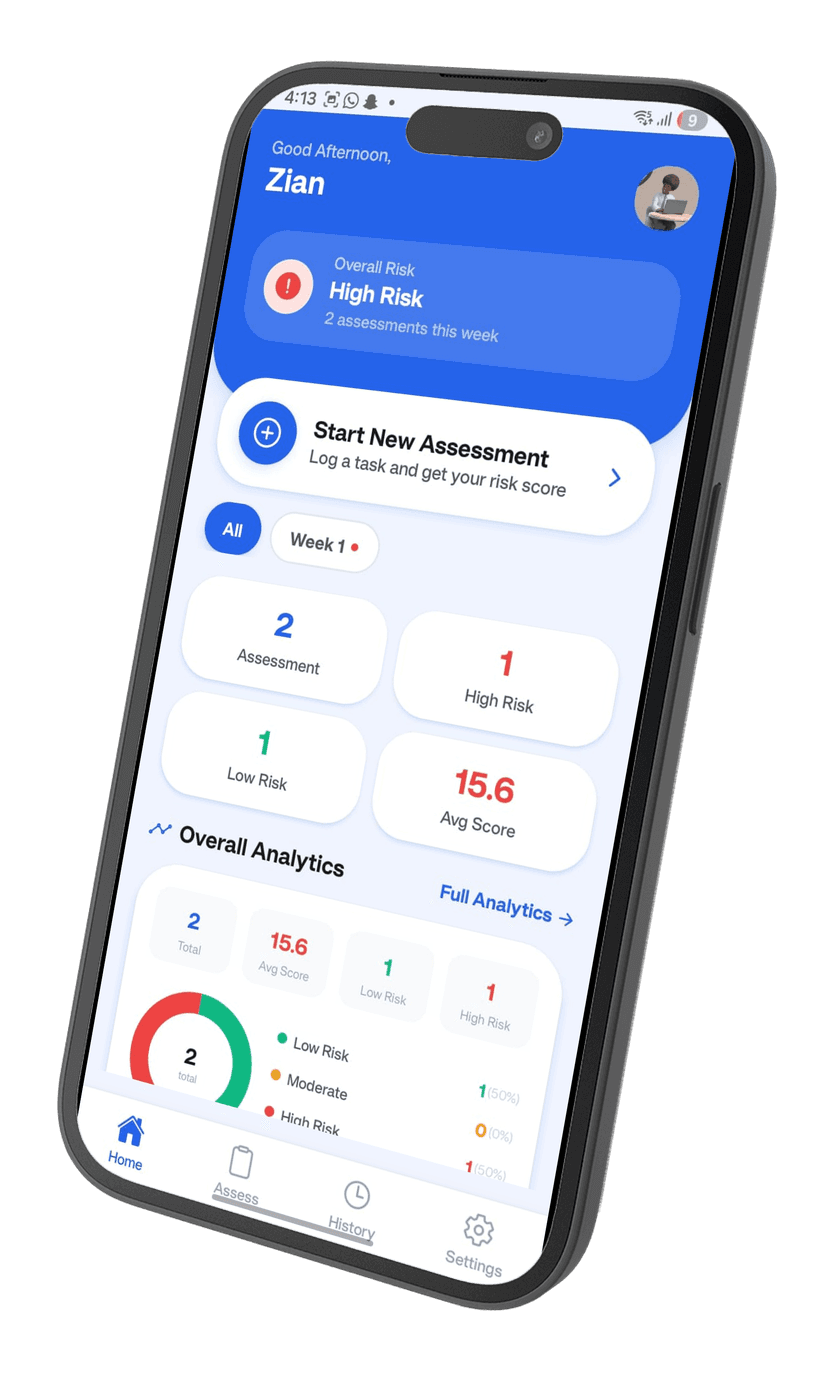
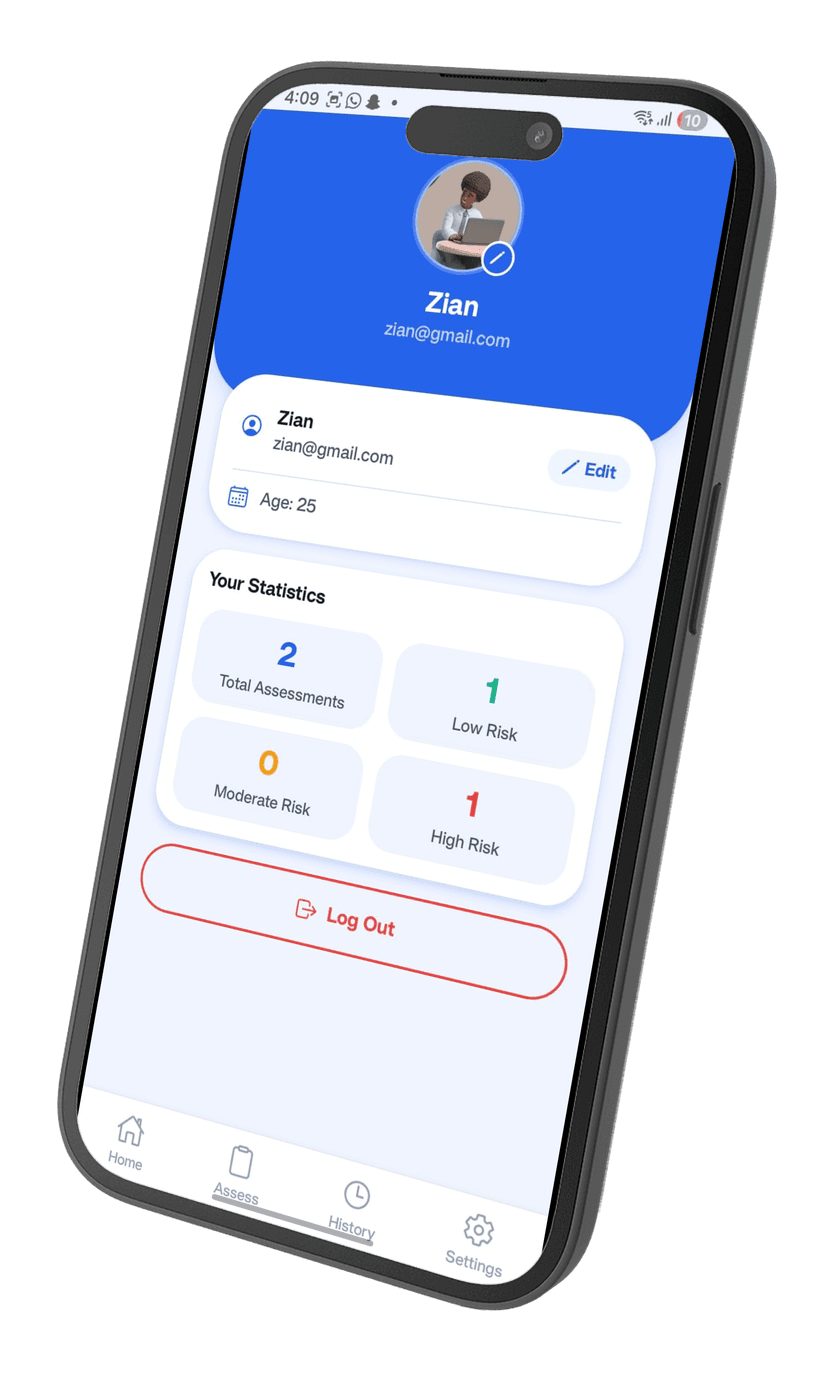
Everything above happens inside a single, deliberately simple app — a few taps to log a task, one traffic-light result, and a trend line that quietly builds itself in the background.
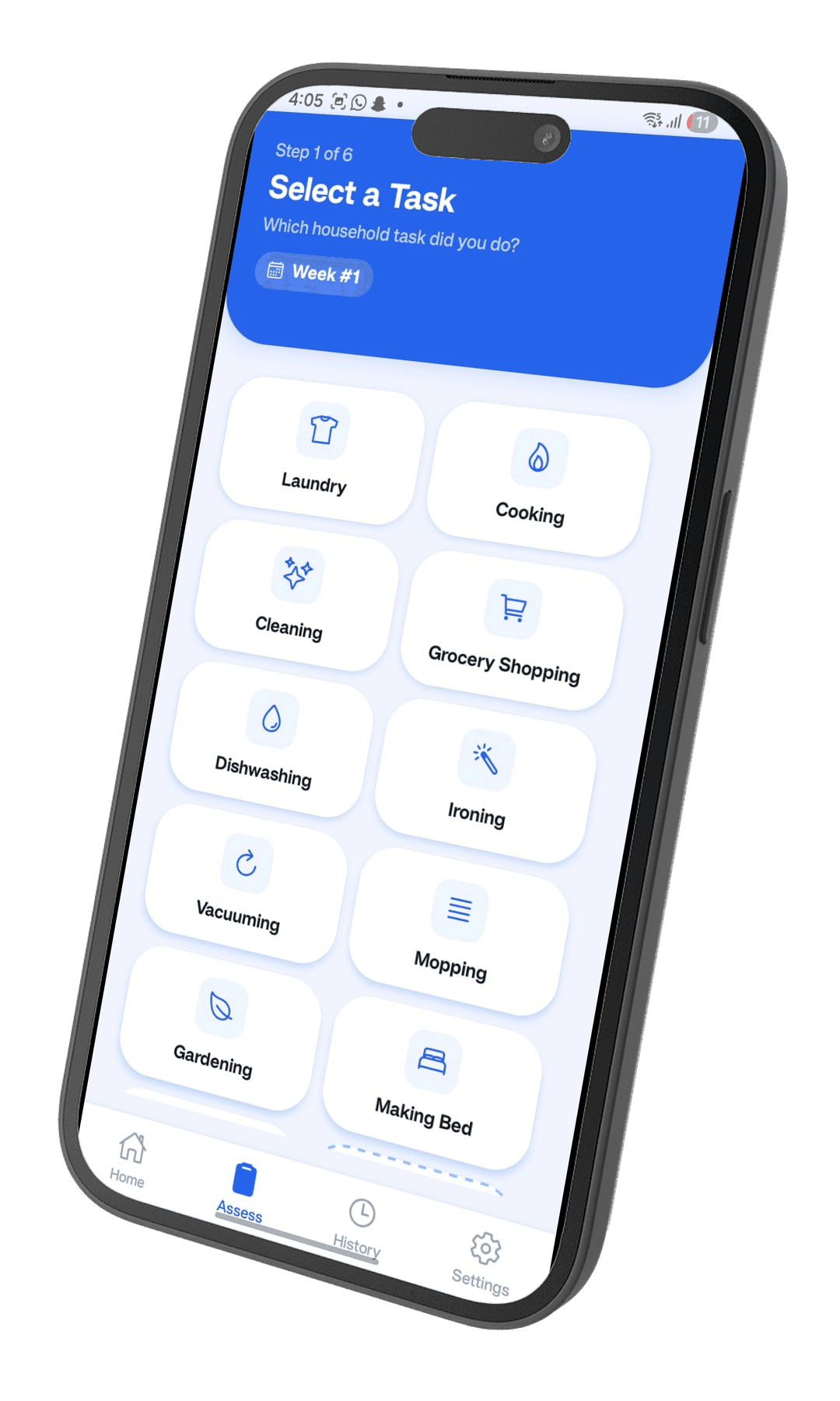
The flow adjusts as you answer — if you didn't lift anything, lifting questions are skipped automatically.
Every task returns a Green, Yellow or Red result the moment it's logged, with a plain-language reason why.
Weekly patterns and repeated high-risk tasks surface automatically, so decline is caught early rather than in hindsight.
When linked to a healthcare professional, the same data reaches their dashboard — with alerts on worsening tasks.
Optionally record a task for a clinician to review, stored securely rather than described from memory.
A patient summary can be viewed in-app or exported as a PDF to bring to — or send ahead of — an appointment.
Try it yourself
This is a working model of TAERI's exposure-score algorithm — the same three parameters and thresholds validated in the original research. Change the answers and watch the traffic light respond.
Low risk
Task is manageable — keep it up with a little caution.
Risk bands: Low < 1.6 · Moderate 1.6–5 · High > 5. No prior training required.
The research
TAERI isn't a wellness app dressed up in clinical language. It's the direct digital descendant of PhD research undertaken at the University of Sheffield, published in the International Journal of Public Health and Clinical Sciences.
2015–2018
2015–2018
Working alongside occupational therapists and watching people perform ordinary domestic tasks made one thing obvious: assessment tools built for factories don't fit homes. That observation became TAER — a paper-based methodology assessing Psychological Perception, Adopted Postures, and Manual Handling.
2018–2020
2018–2020
The methodology worked, but the format didn't scale: manual scoring was slow and error-prone, nothing was tracked over time, remote monitoring wasn't possible, and clinicians had no way to flag risk before an appointment.
2022–2024
2022–2024
TAER became TAERI — retaining every validated parameter while adding instant scoring, personalised feedback, and trend tracking through a mobile interface designed for people who've never needed a health app before.
2025–present
2025–present
Continuous monitoring, tailored recommendations, and secure clinical connectivity now sit alongside the original methodology — reducing reliance on in-person visits without reducing the quality of care.
20
Trial participants
78%
Sensitivity
74%
Specificity
76%
Accuracy identifying discomfort
The science remained. The delivery changed.
TAER — 2015–2018
TAERI — today
Built on science
Human Factors
Research phase
Ergonomics
Research phase
TAER Validation
Research phase
Digital Health
Research phase
TAERI
Validated intervention
Beyond ergonomics
The core TAERI assessment covers effort, posture and handling — but none of that captures balance, one of the strongest predictors of a fall at home. The Fall Risk Indicator closes that gap with a single, deliberately simple question:
"How stable did you feel during this task?"
It's scored separately from the ergonomic exposure total and shown alongside it — so a task can look ergonomically fine while still raising a stability flag that's worth acting on.
Very stable
Low perceived fall risk
Somewhat unsteady
Moderate perceived fall risk — worth a note
Very unsteady
High perceived fall risk — triggers a safety flag
Why TAERI is different
Traditional assessment
TAERI
Who it serves
TAERI doesn't replace clinical care — it fills the gap between appointments, for everyone involved in it.
TAERI stays focused on familiar chores — cleaning, laundry, shopping, personal care — and helps people see which tasks carry risk and how to perform them more safely, without turning daily life into a clinical exercise.
For Clinicians & Caregivers
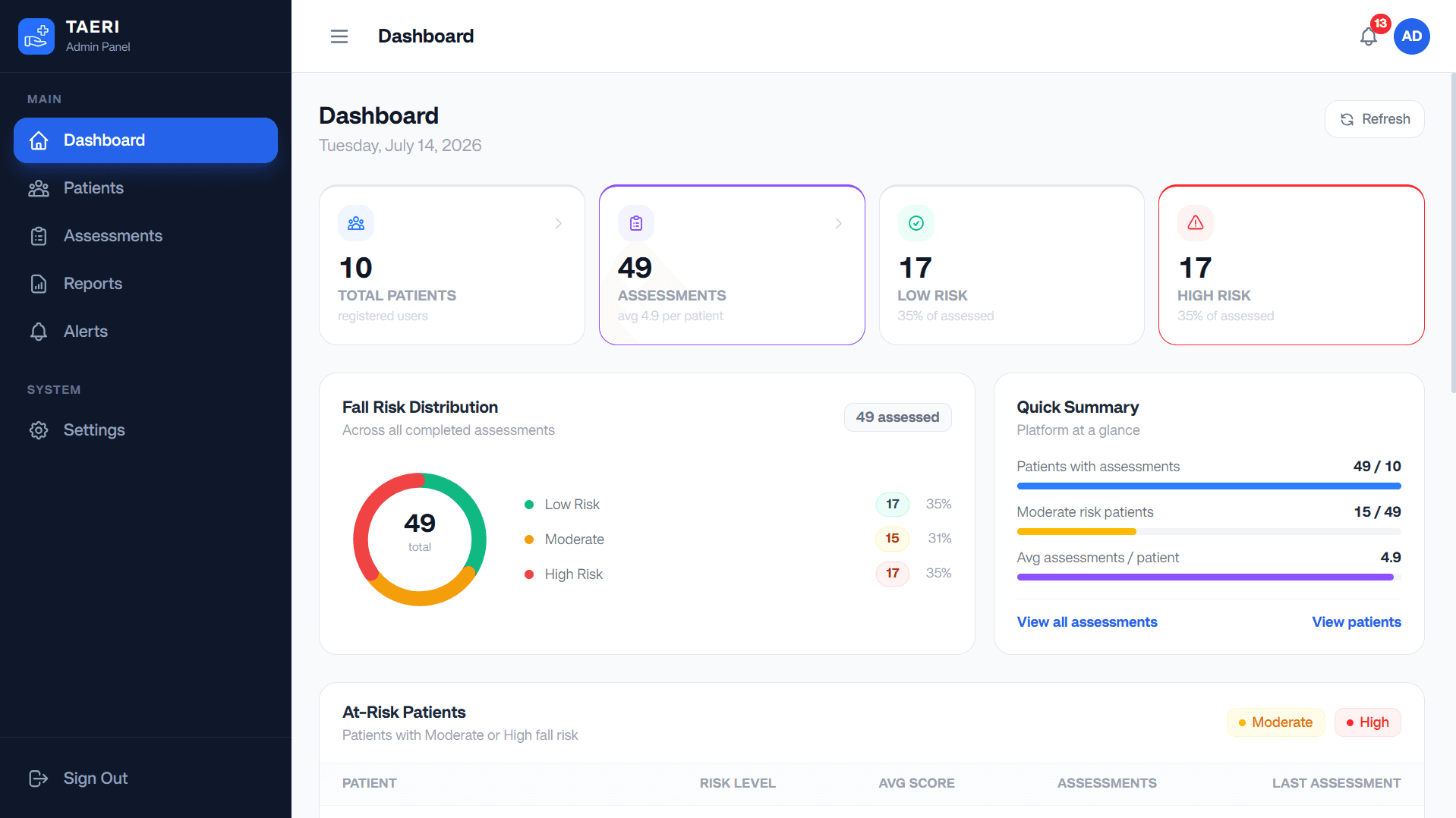
The TAERI clinician dashboard gives doctors and caregivers a real-time view of every patient's fall risk. Monitor assessments, track risk trends, and act before an incident occurs — all without leaving your desk.
Live patient risk scores
See every patient's latest assessment result and overall risk classification at a glance.
High-risk alerts
Get instantly notified when a patient's score crosses the high-risk threshold so no case is missed.
Assessment history & trends
Review a patient's full assessment timeline to identify declining mobility or improving outcomes.
Key innovations
Development roadmap
TAERI is progressing deliberately through clinical validation — not skipping straight from idea to app store.
Research
Complete
Prototype
Complete
Co-design
Next
Pilot Study
Next
Clinical Validation
Future
Healthcare Implementation
Future
Why TAERI matters now
TAERI supports the global shift from reactive healthcare to proactive, person-centred care.
Let's build the future together
TAERI is at the co-design and pilot stage — the right partners now shape what clinical validation and rollout look like next.
Health Systems
Universities
Occupational Therapists
Innovation Programmes
Research Funding
Industry Partners
Vision
Imagine a future where everyday activities become opportunities to detect risk — not missed warning signs.
To empower people to maintain independence, safety and quality of life by proactively identifying ergonomic and balance-related risk in the home — before it results in injury or functional decline. The vision is a holistic, connected telehealth ecosystem that combines validated ergonomic assessment, fall risk awareness and personalised intervention within routine care.
TAERI
Questions
TAERI is built on the validated TAER methodology from peer-reviewed ergonomic research — not general wellness heuristics. It's designed specifically to surface injury and fall risk in home tasks before they cause harm, not to track steps or mood.
No. The original paper-based TAER tool required no prior training and remained accessible to people with low literacy — TAERI keeps that same simplicity, just delivered through a guided digital flow.
No — it's calculated and displayed separately from the ergonomic exposure score, so you get a complete picture of both physical strain and perceived stability without either one masking the other.
No. TAERI is designed to strengthen existing clinical pathways — GP services, community OT and physiotherapy, falls prevention programmes — by giving them information they wouldn't otherwise have between appointments.
You get a plain-language explanation of why, along with a practical suggestion for reducing the risk. If you're connected to a clinician, a persistently or repeatedly high-risk task also raises a flag on their dashboard.
Try the live scoring model above, or get in touch about piloting TAERI with your service.
App Preview